Finding God in the City: A Contemplative Journey
Most people are taught that if they want to encounter God, they should go somewhere quiet, into nature, away from noise, beyond the city.
But what if the city is not an obstacle to contemplation?
What if it is one of its most overlooked classrooms for contemplation?
As I reflect on my early years, I have come to recognize that the contemplative life was already taking shape within me, long before I had language for it. It was not formed through structured teaching or intentional practice, but through openness, wonder, and a quiet receptivity to a Presence beyond me.
I remember lying in a patch of green space near my home, gazing up into the vast sky. My thoughts would drift into the mystery of infinity. Even when I tried to imagine an end to the universe, my mind could not contain it; it simply went on. I found myself asking, what kind of power could create something so boundless? Who could hold such immensity?
Then, interrupting my wonder, a jet would roar overhead low and thunderous. I lived beneath the flight path of planes traveling to and from O’Hare Airport in Chicago, and I was captivated by them. The sheer weight and power of those aircraft stirred something in me: awe, curiosity, and a sense of human ingenuity that felt almost mysterious in its own way.
Those moments—lying on my back in silence, caught between the vastness of the heavens and the force of human invention—were, though I did not know it then, deeply contemplative. They were spaces of quiet awareness, where I encountered both mystery and presence.
At the time, I held a simple awareness of God: a God of love, power, and vastness. Yet the loss of my father in a car accident introduced a complexity to that awareness that I was not yet equipped to process (a story for another time). Still, even in that unresolved space, something remained: a connection to God through silence, observation, and reflection.
What I now understand as contemplation was then simply an experiential inquiry, a living curiosity about God, the world, and my place within it.
As I grew older, I became involved in Christian youth groups and evangelical churches. There, the emphasis was placed on Scripture, reading, studying, and understanding the Word of God. This formed a strong and necessary foundation in the life and teachings of Jesus. And yet, something in me remained quietly tethered to those earlier experiences, the sense that God was encountered not only in Scripture, but also in creation and, intriguingly, in human invention.
Years later, I encountered the writings of Ignatius of Loyola and his Spiritual Exercises. It felt like returning to my childhood backyard. Ignatius’ insight that God is in all things awakened something familiar and long dormant.
God is everywhere, this we often affirm. God is present, in a mysterious way, in human invention. That realization reshaped how I experienced the world, especially the city.
We often associate contemplation with mountains, oceans, and silence. And rightly so. These places open us to God’s presence. But the city opens up to us, if we are willing to see the presence of God. As I walk among people, structures, systems, and movement, for me, it becomes a form of contemplative prayer.
As I learned about the early desert fathers and mothers—the Abbas and Ammas—I began to see that contemplation was never confined to geography. It is not dependent on silence alone, but on awareness. It is a way of seeing.
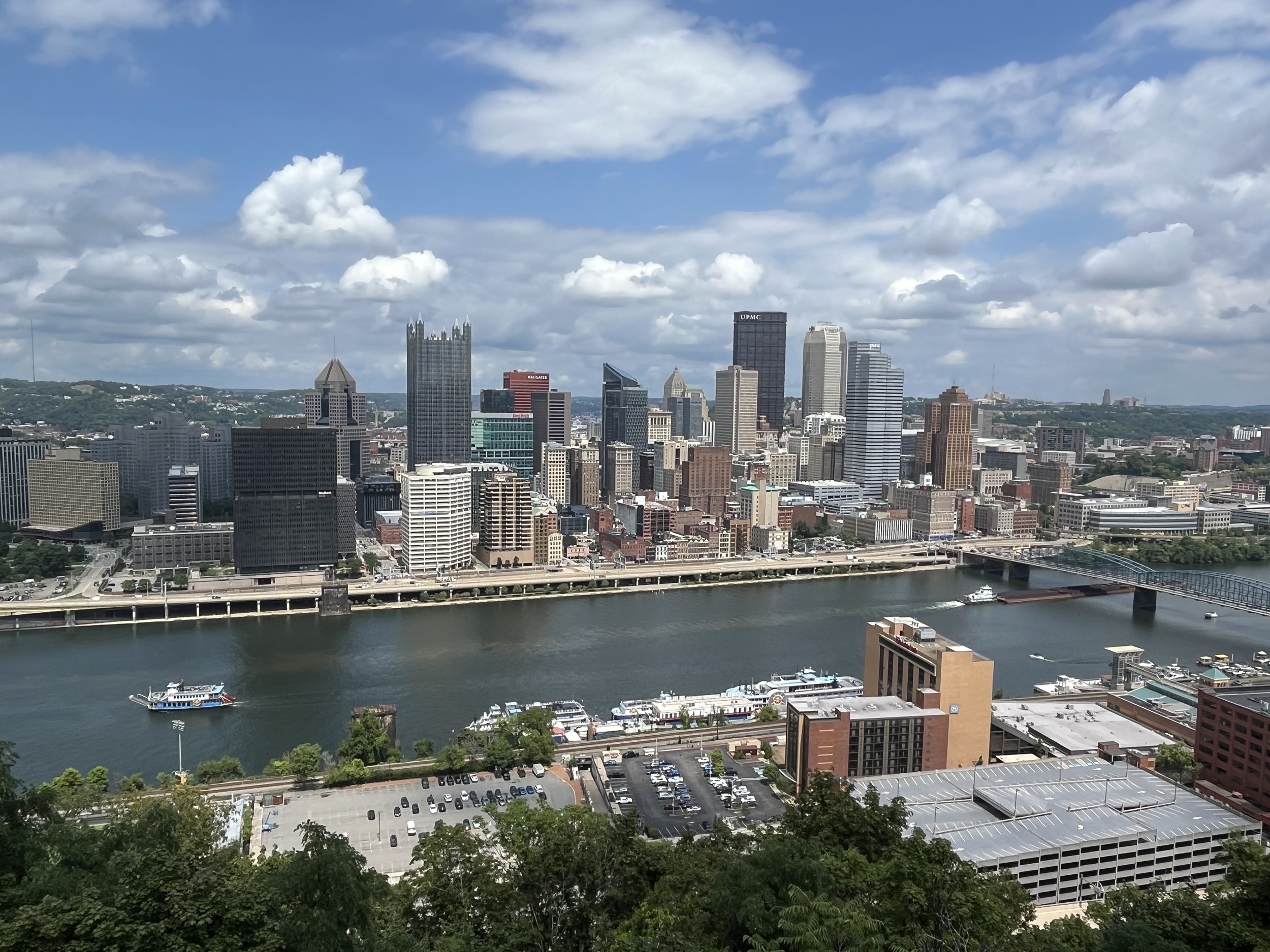
This freed me. In response, living in Pittsburgh, I would often go to an overlook on Mount Washington and gaze out over the city. The skyline, the rivers, the bridges. Everything seemed alive with meaning. In those moments, I was not escaping the city to find God; I was discovering God within it.
God’s Creation in the City
Even in dense urban spaces, creation insists on being seen. I noticed how creation is seen in the city. Trees and plants pushing up through concrete, a quiet testimony to God’s presence and persistence. God refuses to be shut out and is present in the midst of the city. As trees and plants grow up in the cracks of concrete, I am reminded that growth springs up in the hard places.
Light and shadow on buildings remind us that the sun still governs the day. The city cannot outshine the sunlight. I am encouraged that the light of God cannot be extinguished. I observe the birds navigating traffic patterns through the city's structures and activity. I am amazed by how creatures adapt, improvise, and survive. This provides encouragement to adapt, improvise, and strive amid the empire’s structures, systems, and barriers.
As I walk through the city streets, I experience the wind moving between skyscrapers. The gust of wind seems to come from nowhere. The unexpected wind causes me to pause. I reflect that the ancient metaphor of Spirit is still alive in modern corridors.
Continuing to walk along the sidewalks, I notice the variety of human faces brings the realization that each one bears the image of God, each one a mystery, each one beloved.
As I enter the open spaces, I look along the skyline, with the sky framed by architecture, and I am reminded that the heavens always exceed what we build. The heavens are over the structures of the city.
Creation in the city often comes as an interruption, a surprise, or an insistence. It brings to mind where humanity's endeavors intertwine with the presence of God. The city is a quiet witness that God’s world is deeper and more enduring than ours.
Passing through the historic districts, I come to impoverished communities crying out. It is a living testimony that gives rise togroans for justice in the city. My heart is grieved by the economic disparities and injustice that inhabit the city. I hold on to the realization that God’s heart is attentive to what is broken, marginalized, and overlooked.
Human Invention in the City
Cities are also filled with what humanity has imagined and built. These, too, can become contemplative signs.
The city's standardized, unique architecture reveals our longing for beauty, permanence, and meaning. Roads and transit systems express our desire for connection and movement, as well as fordivision and disconnection. Public art, graffiti, and murals express our need to speak, protest, remember, and hope. Commerce and storefronts speak of attempts to meet needs, create value, and sometimes soothe deeper anxieties.
The noise and pace of the city expose both our drive for productivity and our fear of stillness. Technology reflectscreativity and ingenuity, while also tempting us toward control.Human invention reveals both our glory and our ache: we are image-bearers, capable of creativity, yet often restless—searching for security apart from God, and at times contributing to injustice.
Holding Both Together: “All of What God Is In”
This is where the contemplative vision deepens. A contemplative walk does not divide the world into sacred and secular. Instead, it allows everything to become a teacher.
I carry questions like these:
Where does God’s life pulse through creation here, even in small ways?
Where does human creativity echo the creativity of God?
Where does human invention reveal a longing for God, even if unnamed?
Where does the brokenness of the city reveal both God’s grief and God’s hope?
Where is God inviting me to notice, to soften, to bless, to intercede?
The City as Monastery
In this way, the city becomes a kind of urban monastery, not because it is quiet, but because it is alive.
Alive with signs of God’s presence.
Alive with the imprint of God’s image.
Alive with longing.
Alive with invitation.
And perhaps, if we have eyes to see, every street becomes sacred ground.
My Encouragement
The next time you find yourself walking through a city , a town, or a neighborhood street, resist the urge to rush past it.
Slow down, if only inwardly.
Look again.
Notice what is alive.
Notice what is reaching.
Notice what is breaking through.
Notice what is revealing the human heart.
And then ask, gently: Where is God here?
You may discover what I did long ago, lying in the grass between concrete and sky, that God has never been absent. Only waiting to be seen.